

Highgate Neighbourhood Forum response to Haringey Draft Local Plan
- Borough-wide policies
- Vision for Highgate Neighbourhood (Policy HGN1)
- CIL Projects
- Co-ordination with TfL and other boroughs
- Highgate Site Allocations
- Borough-wide Policies in detail;
6.1 Housing
6.2 Transport
6.3 Green and Blue Infrastructure
- Borough-wide policies
- We support Haringey’s commitment to becoming a zero-carbon borough by 2041, as well as policies to build climate resilience, manage flood risk and improve air quality.
- We would like to see nature-based solutions like rain gardens, more trees, green roofs and sustainable drainage, as well as an emphasis on energy efficiency and renewable energy sources.
- We support Draft Local Plan proposals to safeguard Green Belt and other open spaces and watercourses from inappropriate development. We agree that all proposed developments should incorporate urban greening and biodiversity net gain and that watercourses should be de-culverted where possible.
- We support the Draft Local Plan’s emphasis on Healthy Streets that prioritise walking and cycling and reduce air and noise pollution with the provision of more trees and greening, particularly on Archway Road.
- We encourage the Borough to work with TfL and our neighbouring boroughs to improve the Archway Road (A1) (which runs through our area) and also Highgate High Street, which is shared by Haringey and Camden, with improvements to pedestrian safety with traffic calming, crossings and improved public realm routes, particularly around schools.
- We support the Draft Local Plan proposals to significantly increase housing delivery across Haringey, prioritising affordable homes and high-quality design than supports health and wellbeing and offers opportunities to enhance community involvement in the process and on-going management ,as well as community-led developments specifically.
- Vision for Highgate Neighbourhood (Policy HGN1)
We support Haringey’s Vision for Highgate:
The proposed placemaking approach for Highgate aims to:
- Build around 400 new homes and create more jobs, mainly near Archway Road and Highgate Station. Ensure that these schemes provide high-quality, design-led, sustainable homes offering a mix of tenure and 50% social housing meeting the local social need.
- Protect heritage by preserving historic buildings and streets, acknowledging and working with local civic organisations, including Highgate Society and Highgate CAAC. In particular, with regard to Archway Road historical shop frontages and buildings and with regard to Highgate’s historical High Street and back yards, which have limited access via historic lanes and routes and have recently suffered significant damage due to development through impact of deliveries and building work.
- Support local businesses through support for public realm improvements, active, safe and public transport improvements and resisting residential conversions in Highgate High Street, Archway Road, and Aylmer Parade. The Plan should support the introduction of an Article 4 Direction removing permitted development rights for Class E to C3 conversions on Archway Road.
- Support local businesses, organisations and cultural venues to develop initiatives to promote local retail centres through the work of various council departments.
- Improve travel by making walking and cycling safer and easier, especially across Archway Road from the residential areas east of the Archway Road and Crouch End (paragraph 16.05).
- We greatly welcome the emphasis on placemaking that makes sites less car-dominated, improving safety and pollution, and improves pedestrian and cycle connections. Small-scale interventions, incorporating street trees, greening and outdoor seating, are welcome as improvements before more capital-intensive and complex traffic solutions can be implemented. For example, at various points along the Archway Road, particularly at the junction with Shepherds Hill and Jacksons Lane, where there have been several traffic accidents.
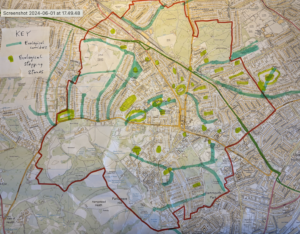
- Enhance green spaces like Parkland Walk and Highgate Bowl, and boost protection for our existing mature trees. We draw attention to our proposals for biodiversity corridors and stepping stones within Highgate (see map in Appendix 1) and ask that they be incorporated into the Borough’s plans for connecting parks and open spaces. We are working with other local groups across North London to develop these corridors across borough boundaries.
- Provide community facilities such as play areas and cultural spaces for all ages. Support our local cultural and community infrastructure through initiatives like the Highgate Festival (now in its 9th year) and ensuring Highgate and, in particular, the rich cultural history of Archway Road forms part of the Haringey Borough of Culture in 2027.
We support ARAG’s request to re-designate Archway Road as a District Centre, reflecting its size, function and importance, not just in terms of retail uses, but also as a hub for artistic and creative communities.
- CIL projects
The HNF has two important existing CIL projects that we would like to see expedited as soon as possible as the funding was allocated some years ago. Both projects meet the policies in the existing and the proposed Local Plan.
Natural Play and seating along Parkland Walk – a light-touch proposal to distribute several natural play and seating structures (balancing logs etc) along the route to provide moments of rest and play for children, people with disabilities and the elderly to broaden the use of this important green space.
Active Play Track and Nature Trail (next to Highgate Library, Shepherds Hill) – new improved active play track designed for use by diverse ages (balancing bikes, scooters and bikes) with additional seating set within an upgraded, managed and protected natural space with educational signage to engage users with nature. This will provide a much-needed play and outdoor cultural space for older children in the area and for other locals as a natural piece of public realm close to cultural venues such as Jacksons Lane and Highgate Library.
- Co-ordination with local boroughs
The Highgate Neighbourhood Forum remains ready and able to enable and encourage co-operation between the boroughs and TfL and will continue to inform each of them of relevant activities by the other. Limited co-operation and dialogue between Haringey and Camden (and to a lesser extent Islington and Barnet) has always been an issue for Highgate. Although a much older entity than any of the boroughs, it has struggled to be recognised as a joined-up neighbourhood and we would support any initiatives that address this issue.
- Highgate Site Allocations
We approve these site allocations but – as many have been cited since our Neighbourhood Plan of 2017 – wonder whether affordable and social housing projects will actually happen and importantly at what scale. We would be grateful to be kept informed of any progress on the various site allocation developments.
HG SA03 – 460–470 Archway Road (Wellington Sidings)
We also support a more ambitious scheme for the partial pedestrianization of Wellington Roundabout and “creating a more attractive, walkable public realm and new public spaces” particularly in light of the new, proposed housing on the island site and possible development of HG SA03 – 460–470 Archway Road (Wellington Sidings) as part of the new site allocations in the area.
- Borough-wide Policies in detail;
6.1 Housing
Policy H1: Meeting Housing Needs
We support the council’s ambitions to build its own Social Housing provision as it is not only affordable, can be more tailored to the actual needs of the borough but also gives a level of security that other forms of tenure do not provide. We would like to see a greater emphasis on alternative economic, management and ownership models that mitigate against market-led problems and support the emergent landscape of residents, professionals and funders who are creating new methods for a more equitable delivery and provision of housing in London. Organisations like Community Land Trusts London, Community-led Housing London, Collective Ownership UK and Co-operatives London are keen to work with councils to deliver more homes.
We would like to see the inclusion of a requirement for consideration or inclusion of community-led housing in all large sites. For example, an expectation that at least 5% of homes are community-led (compared to 10% in St Clements and 6% in St Ann’s). This expectation would be tenure-blind, so homes could either focus on a particular tenure, or might cut across any mix of market and affordable housing, so as not to place an additional burden, while giving greater control and belonging.
In this vein, we would like to encourage the council not to place requirements that low-cost rented homes provided by community-led organisations have to be Registered Providers, as many community-led developers struggle to become registered with the current high bar for registration. Organisations such as housing co-operatives and CLTs may be well placed to take up smaller numbers of rented homes provided by section 106 agreements, which have otherwise struggled to find RP providers.
In particular, we would like to be informed of any intention to deliver more housing on the Hillcrest Estate which has been proposed for some years. The estate has consequently suffered blight and recurring maintenance problems, despite action from residents and initiatives like the Community Garden.
Policy H5: Small Sites and Smaller Housing Development
We therefore urge the council to introduce stronger requirements to reduce the risk and complexity for community-led development on small sites. For example, this could include Permission in Principle or the use of Local Development Orders for community-led development on a number of specific small sites, both publicly and privately owned, across the local authority area, allowing community-led development to have clarity on where to focus efforts.
Policy H7: Housing Older People and Vulnerable People
Making clear provision for community led development and custom-build as defined in the NPPF can help people with particular lifestyle needs, aspirations, and choices, including those who want to live in intergenerational arrangements beyond the nuclear family, with a sense of belonging and mutual support, and where they control their homes even as a renter, through a housing co-operative. This is dramatically different to co-living where residents are still tenants of extractive landlords.
Policy H8: Large-scale Purpose-built Shared Living
We would once again encourage the council to build its own or support alternative models of delivery, management and ownership on smaller sites that require a smaller economic investment. They also offer important opportunities to provide models such as housing for the elderly, disabled and sheltered housing as well as intergenerational models that particularly benefit from proximity to transport and community amenities.
The council can reference
Groups such as the Rural Urban Synthesis Society have delivered intermediate rented homes at London Living Rent levels, which stay permanently affordable, without the ability to purchase/ sell the unit. Gida Housing Co-operative are looking to do the same at St Ann’s.
https://www.ustsc.org.uk/almshouses/new-almshouse/
https://www.collectiveownership.co.uk/
- Proposals for additional housing on private residential gardens will not normally be permitted and loss of garden land will only be considered acceptable where the proposal is for comprehensive redevelopment of a number of whole land plots where adequate gardens from the donor properties are secured. This could also support the development of large-scale individual houses into multi-occupation premises with a range of housing unit and mixed tenures on offer.
Policy H11: Loss of Existing Housing
We support the policies for the loss and replacement of existing housing to be delivered by the principles and commitments to tenants and leaseholders in the Council’s Housing Strategy.
- Transport
We support the council’s ambitions in delivering Healthy Streets for all. Most importantly, these principles should not only refer to major developments but they should also be a core part of any scale development or renovation, any repairs including Haringey Council’s own and most importantly repairs and work by utility companies.
Policy T2: Walking
We agree with these ideas. Importantly for Highgate High Street, wheelchair users and those with impaired mobility for any reason should be a priority to improve the Haringey side of the High Street. The pavement needs reconfiguring and resurfacing to make it wheelchair compatible and easier for those with visual disabilities or problems with balance. Priority should be given to proposals that calm and reduce traffic with build-outs, that also allow for seating and greening.
- Proposals which remove or reduce the impact of street clutter will be supported
This policy should not just be for development but an ambition to map and remove existing street clutter – most of which comes from the council. We would like to propose a council-led task force to remove unnecessary street furniture, with support from local communities to identify objects for removal. Where lit signs are introduced, they should be powered by solar panels if possible.
Policy T3: Cycling
We support policies to assist with safe cycle travel, in particular, with east–west routes that are more accessible to a range of cyclists including children and the elderly. We need increased provision for cycle lanes, eg. on Muswell Hill Road towards Muswell Hill and across Archway Road to the residential areas providing safe cycle routes for school children and parents heading to the school in Highgate including Highgate Primary School.
This includes more cycle hangers or sheds that should be made from sustainable materials and have green roofs.
There should be an aim to co-ordinate with TfL so bus lanes become 24/7/365 and are shared with cyclists.
Policy T4: Public Transport
Haringey should work towards better East-West links. It is very difficult to get from Highgate to Wood Green, where the council offices are located, Tottenham where St Anne’s Hospital and the North Middlesex Hospital are located, and the Lea Valley.
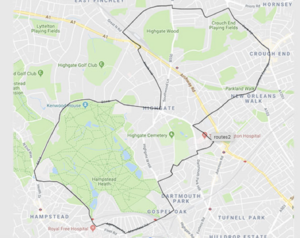
For some years we have proposed a small circular bus service (similar to the W5) to connect to provide some of these links (see map in Appendix 2 below).
PTAL figures should be treated as guidelines only. (Only one small part of Highgate has a PTAL of 4, though Highgate generally has good Public Transport connections. Those connections have only improved with the introduction of the 310 bus and the rerouting of the 263 bus. The area around Highgate Tube station, which is also served by three bus routes, only scores a rating of 3). The reach of hire cycles has also extended up the hill to Highgate should be taken into account with the ratings. Haringey needs a policy for hire bikes or to be part of a London-wide initiative.
We would like to see parking further restricted on narrow roads such as Southwood Lane.
We would like to see improved co-ordination with Camden along the Boundary Roads of Highgate Hill, Highgate High Street and Hampstead Lane.
- Developments involving a net gain of five homes or more should contribute towards the expansion of the local car club network. In light of Zip Car’s closure, Haringey needs a policy for car sharing or to be part of a London-wide initiative.
Any car parking road markings should continue at the present dimensions and Haringey should strongly enforce fines for those whose cars park outside the lines or block passing points on our narrow roads.
Policy T6: Vehicle crossovers
Highgate is largely a Conservation Area and any crossovers are detrimental to the character and will detract from the street scene and the historic environment. Also, anywhere in the Borough, crossover result in a reduction in pedestrian and highway safety.
6.3 Green and Blue Infrastructure
We support the prominence given to green and blue infrastructure with the recognition of biodiversity loss, climate adaptation, ecosystem services, environmental net gain and the urgent need for nature recovery at the local level.
We strongly support the Highgate Society’s calls for enhancement of delivery, long-term management, monitoring and enforcement, particularly where policies rely on 30-year maintenance periods, private management arrangements, or future landownership.
We support the key recommendations to:
Strengthen all relevant policies (notably G1, G4, G5 and G8) to require clearly defined monitoring periods, monitoring frequency, named responsible parties and enforceable remedial actions.
Ensure that developer-funded monitoring contributions are explicitly secured and sufficient to resource the Council’s statutory and practical monitoring role over the full lifespan of biodiversity commitments.
Require that long-term biodiversity and green infrastructure obligations are secured through legal mechanisms that bind successors in title, addressing the reality of land and asset ownership changes.
Prioritise on-site biodiversity delivery, with off-site contributions tightly controlled and strategically directed.
Explicitly align biodiversity net gain, urban greening and green infrastructure delivery with the Draft London Local Nature Recovery Strategy (LNRS), ensuring that local gains contribute meaningfully to London-wide nature recovery priorities and ecological networks.
- General points
Joined-up thinking and delivery within the council
The details of the New Plan should be publicised widely within the Council bureaucracy and the principles embedded within the plans and decisions of all departments. Policy directions including PP5 (Inclusive Economy) and the commitments in PA1 and PA2 (participation, co-design and working closely with stakeholders) should for example lead the proposals for improvements to Archway Road working closely with TfL and the council’s Transport department.
Community empowerment and collaboration
Community groups such as the HNF and ARAG can provide the council with support to bring together community thinking to work with multi-disciplinary teams from across various council departments.
Alicia Pivaro, Chair, Highgate Neighbourhood Forum
January 2026
Appendix 1: Highgate’s proposed green corridors and stepping stones
Appendix 2: proposed new circular bus route

What a depressing picture! The town hall gremlins have obviously taken over the asylum.
A subterranean highway between Highbury and the North Circular going under Highgate Hill would cure many of the traffic problems affecting our area and avoid the need for most of these proposals, which just seem designed to make life difficult for motorists. But sadly the UK seems unable to show the enterprise of some of our European neighbours in investing in something so visionary. The HRF budget obviously does not run to such things, but might be better spent in trying to influence the wider issues affecting our neighbourhood rather than dabbling in the minor prejudices covered here.
Just for the record – and to stave off any confusion – I imagine it is clear to everyone that a tunnel under the A1 between Highbury and the North Circular will never be built both for economic and practical reasons. As to the “wider issues affecting our neighbourhood”: every survey of opinion in Highgate has put Traffic and Transport at the top of concerns and so any proposals to improve matters for active travel and public transport users (who far exceed car owners in Haringey) will always receive serious consideration on our part.